Have you ever been conflicted by two opposing opinions? Both opinions had merit and seemed logical—but—they also seemed to contradict each other. One of the most pervasive debates amongst educators, especially those involved in reading instruction for emerging readers, struggling readers, and English language learners, is: what approach is best when teaching reading: a phonics-based approach or a whole-language based approach?
Here are the insights of Dr. Neil J. Anderson, former TESOL President, on which of these is the most effective when providing reading instruction for ESL students. All italicized text is transcribed (with slight modifications for readability) from Dr. Anderson’s webinar presentation for Reading Horizons, Holding in the Bottom while Sustaining the Top: A Balanced Approach for L2 Reading Instruction.
To begin, here are Dr. Anderson’s definitions of the two different approaches used for teaching reading to ESL students:
The Top-Down Approach to Reading Instruction for ESL Students
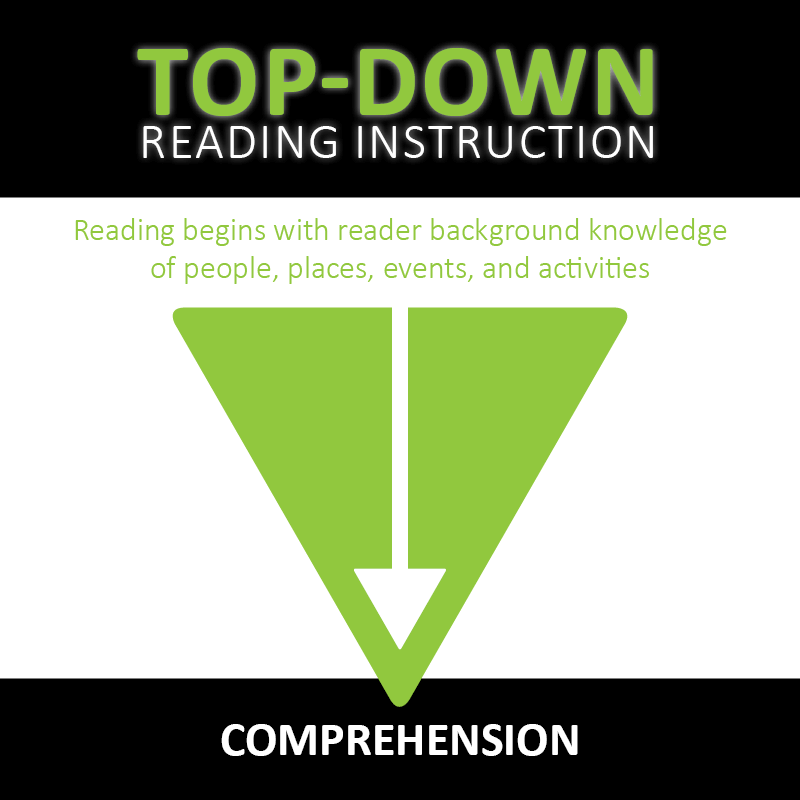
A top-down approach says that reading begins with readers’ background knowledge of people, places, events, and activities and you use that background knowledge to drive reading comprehension. The big picture drives instruction and is used to help students gain comprehension. This is what most educators would refer to as a “whole-language approach” to reading instruction.
The Bottom-Up Approach to Reading Instruction for ESL Students
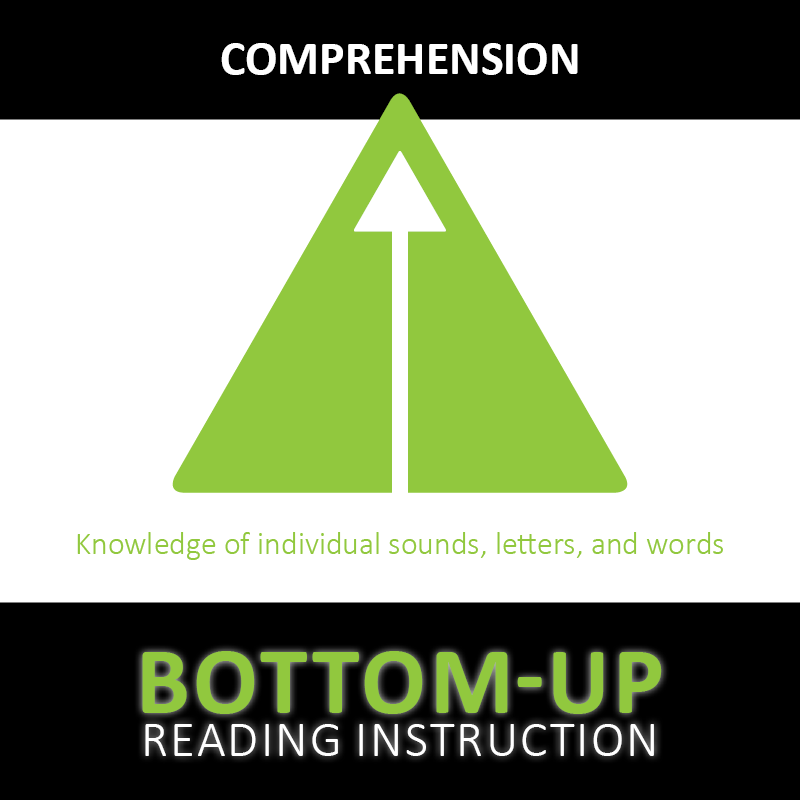
The bottom-up approach provides knowledge of individual sounds, letters, and words, and we help learners develop that knowledge and use that knowledge to drive comprehension. This is what most educators would refer to as a “phonics-based approach” to reading instruction.
Which Approach is the Most Effective for Teaching ESL Students?
The more that I’ve learned about teaching reading… it’s really the combination of both bottom-up and top-down reading strategies that we want learners to get into place. Teaching top-down strategies actually is pretty easy, and most English language teachers do that very well. But unless you know the rules for decoding the words in English—we’re not adequately giving the students the bottom-up skills that they need.
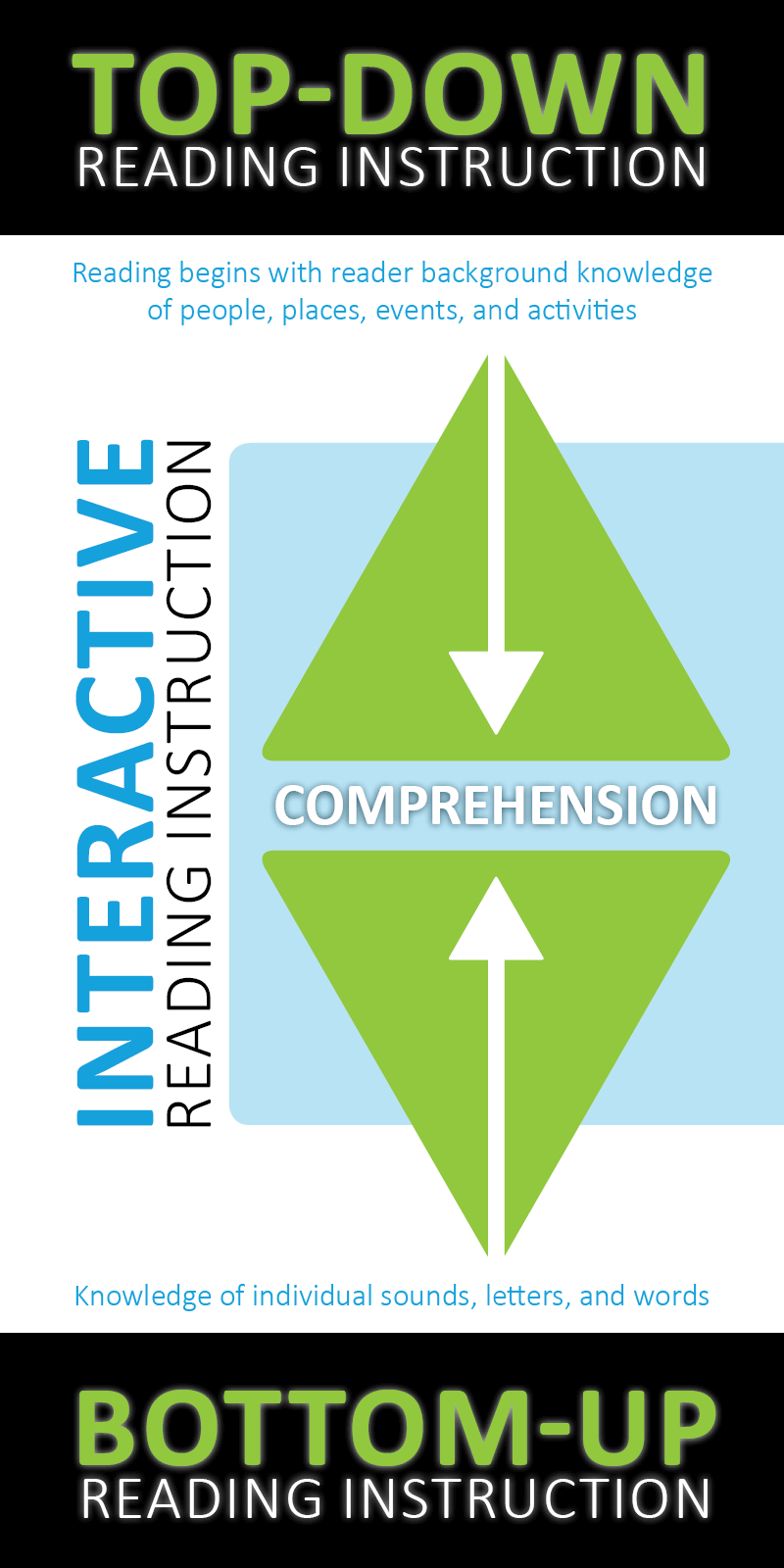
What I find so interesting in primarily the first language reading literature that addresses top-down and bottom-up approaches is that they place the argument as if this is an either or… you’re either top-down or bottom-up, but for many years we’ve known that really reading is an interactive process that involves both bottom-up and top-down strategies. And both work together simultaneously to help us in our instruction of getting readers to the goal of comprehension.
In a book I recently read for the Reading Horizons Book Club, Built to Last: Successful Habits of Visionary Companies, by Jim Collins and Jerry I. Porras, it discussed how successful companies are able to embrace two opposing ideas at the same time—just as Dr. Anderson recommends for successful ESL instruction. Here is an excerpt from the book:
“…a key aspect of highly visionary companies: they do not oppress themselves with what we call the ‘Tyranny of the OR’—the rational view that cannot easily accept paradox, that cannot live with two seemingly contradictory forces or ideas at the same time. The ‘Tyranny of the OR’ pushes people to believe that things must be either A OR B, but not both.
… Instead of being oppressed by the ‘Tyranny of the OR,’ highly visionary companies liberate themselves with the ‘Genius of the AND’—the ability to embrace both extremes of a number of dimensions at the same time. Instead of choosing between A OR B, they figure out a way to have both A AND B.
… Irrational? Perhaps. Rare? Yes. Difficult? Absolutely. But as F. Scott Fitzgerald pointed out, ‘the test of a first-rate intelligence is the ability to hold two opposed ideas in the mind at the same time, and still retain the ability to function’.”
Here is the approach that Dr. Anderson recommends for effective ESL reading instruction—a combination of both top-down and bottom-up strategies:
A Balanced Approach to ESL Instruction
Eskey (1988) pointed out 25 years ago that second language reading instruction “exhibit[ed] a strongly top-down bias” (p. 95) and thus as second language reading specialists, we needed to do a better job of helping L2 readers “hold in the bottom” by including systematic decoding instruction as part of a second language reading curriculum as well as instruction on how to effectively use top-down strategies.
In Eskey’s words:
“In practical terms, my concern is thus to keep the language in the teaching of second language reading. That may not sound very controversial, but I think that in promoting higher-level strategies—like predicting from context or the use of schemata and other kinds of background knowledge—some researchers have been sending a message to teachers that the teaching of reading to second language readers is mostly just a matter of providing them with the right background knowledge for any texts they must read, and encouraging them to make full use of that knowledge in decoding those texts. Though that is certainly important, it is also, I think, potentially misleading as a total approach. . . . We must not, I believe, lose sight of the fact that language is a major problem in second language reading, and that even educated guessing at meaning is not a substitute for accurate decoding.” (Eskey, 1988, p. 97)
This graphic is one that guides my thinking and the curricular development focus and our reading curriculum at our English language center here at BYU. Let’s start with the circles in the middle. We’re a skills-based curriculum at our English language center so we have a listening/speaking class, a reading class, a writing class, and a grammar class.
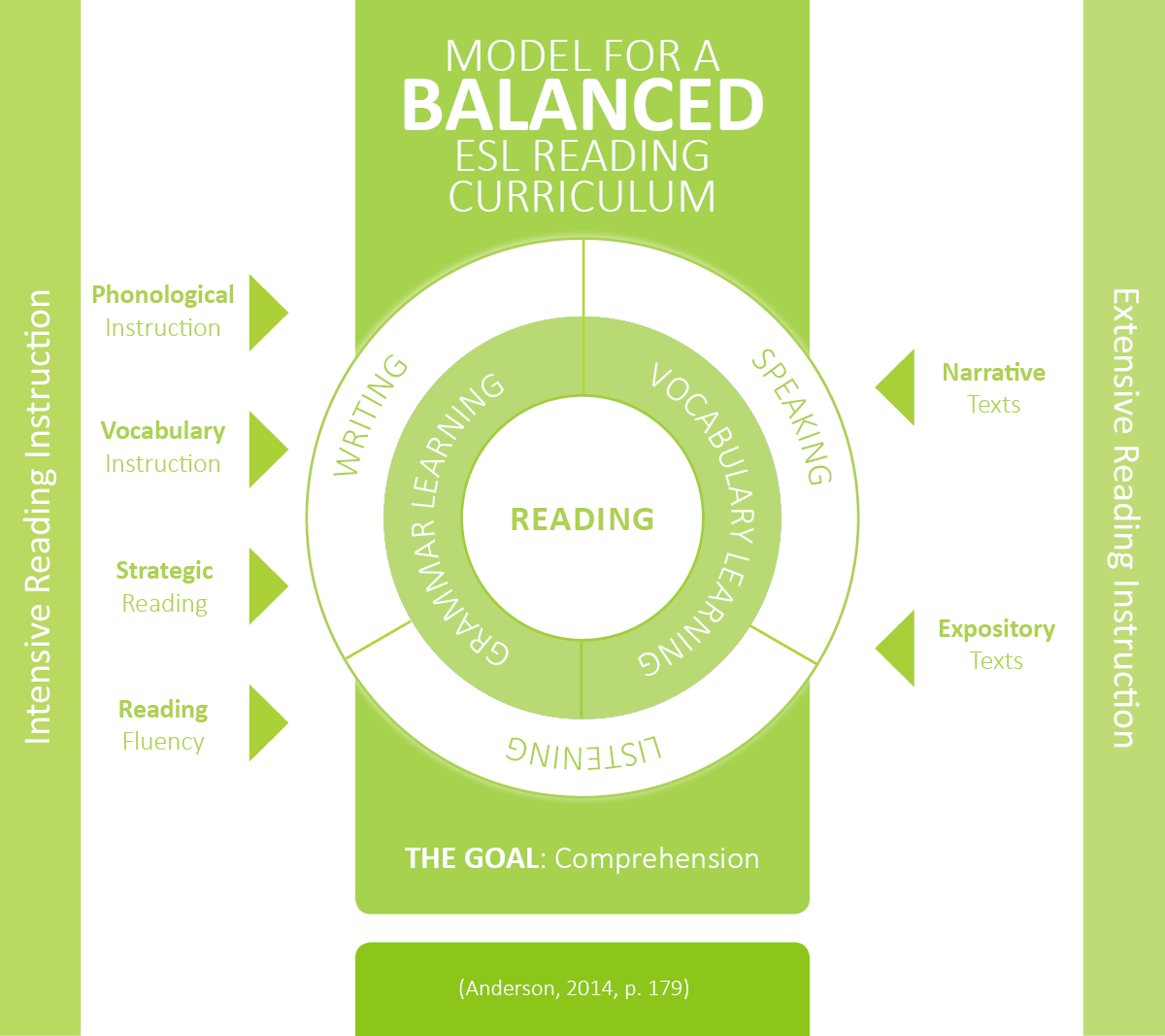
For the reading curriculum, we encourage reading to be connected to the other skills so that learners see that what I’m doing in my reading class is connected to the other classes that they have.
As a reading teacher, I want to make sure that I’m focusing on grammar learning and that I’m providing natural opportunities for the learners to see the grammar they’re studying in their grammar class in the readings that we’re engaged in. We want to make sure that we’re engaging the students in vocabulary learning in that reading class. So that they’re getting the words that they need to fuel their language development and growth. I want to make sure as a reading teacher that I’m focusing on opportunities for writing, speaking, and listening in class—in meaningful ways. Using reading as the springboard for the discussion and the development of these other skills.
In reading, I want to always keep in mind that my goal as an English language teacher is to help the students with their comprehension. And with both the bottom-up and top-down interactive approach, I’m going to be focusing in on comprehension at both ends. Comprehension of sounds, letters, words, phrases, and comprehension of ideas.
We’ve set up our curriculum so that we provide during the intensive reading instruction phonological instruction. Particularly for our lower-level learners. That they’re getting the sound-symbol correspondence. That they’re getting opportunities to practice manipulating words and exchanging different sounds and letters to work-through words and see how those words change meaning when you change just one sound.
We focus on vocabulary instruction during that intensive reading portion, we provide strategies for the students so that they can learn how to be more strategic readers and we also want to make sure that there are opportunities for building reading fluency. That readers are not just at the word level but that they’re learning how to connect larger chunks of words to be a more fluent reader.
We also, for outside of class instruction, provide opportunities for students in extensive reading. And one of the things that we clearly know from research is that narrative texts are different from expository texts in terms of the grammatical structures that are used and perhaps more importantly, in terms of the vocabulary that’s used. So, across our reading curriculum, we provide readers with opportunities to engage with both narrative and expository text.
The percentage of time that we spend on narrative versus expository texts varies depending on the level, at our lowest level were spending about 80% of our reading time with our narrative text and the remaining 20% with expository. As we move through the eight levels of our intensive English program, by the time we get to the highest level, we are having the students do about 80% of their reading with expository texts and 20% with narratives. So that balance shifts as we move learners up the proficiency scale. But we want to make sure that there’s a balance of both kinds of texts in the reading class. And by balance I do not mean 50/50. But just thinking through that there are some types of narrative and some types of expository texts in all of the reading classes through the curriculum.
This model is working in all 8 levels of our program.
Also, here is a portion of a video interview with Dr. Anderson, in which he shares additional insights into effective ELL reading instruction:
How have you found balance in your ELL reading curriculum? What works for you? We’d love to hear your thoughts!