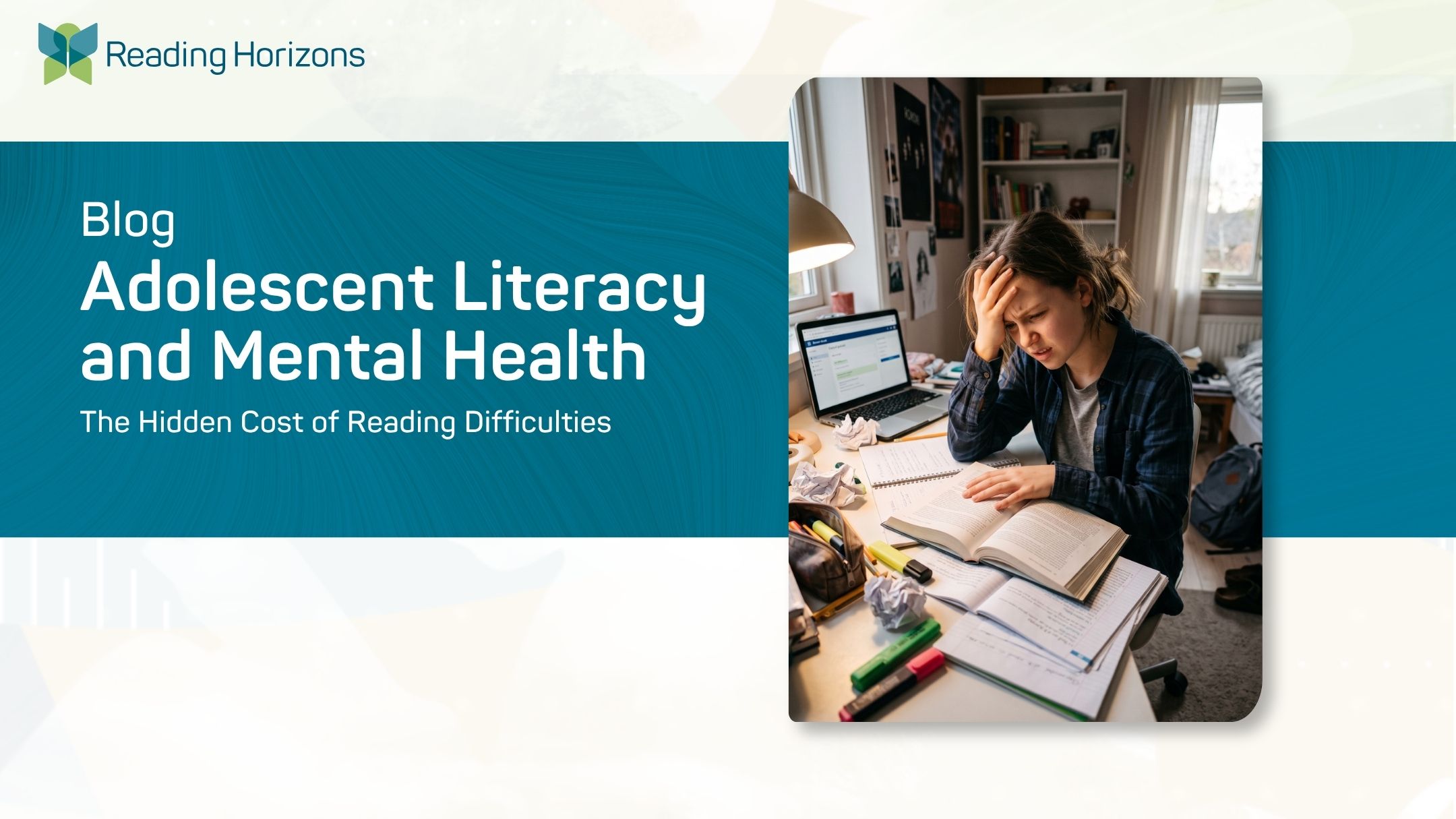
Get practical, research-informed strategies you can bring to your secondary classroom tomorrow, plus a simple framework for responding when students avoid reading.
A high school freshman who reads at a first-grade level has spent eight or nine years watching classmates do something they can’t—often in public, often day after day.
By adolescence, that experience shapes how students see themselves. In our recent webinar, Adolescent Literacy and Mental Health: The Hidden Cost of Reading Difficulties, school psychologist Dr. Paul Black put it plainly: for many of these students, identity gets “framed around what they can’t do.”
Dr. Black was joined by Angelica Hoffman, a reading interventionist who teaches tier 3 students in grades 9–12, and Dr. David Hoffman, a 10th grade English teacher whose doctoral research focused on trauma-informed practices. Both teach at Horn Lake High School in DeSoto County, Mississippi, the largest school district in the state, serving more than 34,000 students across 43 schools in the Memphis metropolitan area.
Here are a few of the ideas they shared. Watch the full recording below.
Reading difficulties and mental health are linked, but not inevitably
Dr. Black noted that about 40% of students with dyslexia or reading difficulties meet the clinical criteria for an anxiety disorder. That’s not everyday nervousness. It’s a diagnosable condition.
But he was careful to point out that the two aren’t “welded together.” Struggling to read doesn’t cause mental health problems on its own. How schools respond to struggling readers is what makes the difference. When the system mostly tracks what students can’t do, and an IEP pulls a student out of a class they enjoy for another dose of the subject they dread, the message adds up.
Avoidance is protection, not defiance
When older students resist reading, it often looks like defiance. Dr. Black encourages teachers to ask what that behavior is really communicating.
For a student who has only experienced embarrassment when they try, not trying is the safe choice. Angelica sees it every day: “It’s protection. It’s 100% protection,” she said. Students don’t want anyone to see what they don’t know.
The catch is that avoidance protects students in the short term while widening the gap over time. The more they avoid explicit, systematic instruction, the further behind they fall.
Safety before skill
Angelica’s approach surprises many administrators. She doesn’t touch the curriculum for the first four to six weeks of the school year. That time goes entirely to building belonging, through team challenges, getting to know each other, and making the classroom feel like a family.
Once students trust that no one will laugh at them, they can make mistakes in front of each other. That’s when real learning starts. Her students have even asked why they don’t do popcorn reading, because they assumed learning meant being exposed for what they can’t do. Her answer: we learn by figuring out how to do it better, together.
Four conditions for a strong classroom community
The presenters described four conditions that make that safety possible:
- Relationships. “I can teach curriculum all day long, but if the student doesn’t trust me, it’s not going to matter,” David said. That means knowing names and stories, showing up at games, and contacting families with positive news before anything negative.
- Predictable routines. Many students don’t know what to expect at home. A posted daily agenda and a consistent class structure give them a place where the ground won’t shift, and time-boxed tasks give them an off-ramp from non-preferred activities.
- Belonging. David put it this way: belonging should be the condition for success, not a reward for it. In Angelica’s room, every student has a job, from peacekeeper to tech helper.
- High expectations with high support. David compares reading to lifting weights: you won’t get stronger lifting 10 pounds, but you never lift alone. “I’m your spotter,” he tells students.
Specific feedback and visible progress
Angelica’s feedback is immediate and concrete, like four omissions this week instead of ten, or six self-corrections. In her words, “Specific feedback is ‘I see you and I care.’”
Progress is visible, and addressed privately. Students track their own data, set their own goals, and choose whether to share. David builds each student a personal data sheet going back to eighth grade, so they can see exactly how far they’ve come.
The results speak for themselves. After three semesters of daily, 92-minute Tier 3 intervention, fewer than 10% of Angelica’s 10th grade students remained below grade level, down from roughly 75% at the start. The cohort averaged more than 250 Lexile points of growth per student, with several gaining between 400 and 700+.
Assessment that points to the barrier
Dr. Black also challenged fellow school psychologists to reconsider evaluations, which shouldn’t stop at determining eligibility. An evaluation should tell a teacher what barrier to teach to, whether that’s rapid naming, orthographic processing, or oral language and listening comprehension. When students and parents learn why reading has been challenging, everything changes.
A simple framework to start with
The session closed with a framework any educator can use when a student avoids reading:
- Notice: What am I observing?
- Understand: Why is the student avoiding? What’s the barrier, and do they believe effort will lead to a different result this time?
- Respond with support: Pair high expectations with explicit instruction and specific feedback.
- Make success visible: Help the student, and their family, see real growth.
Or, in Dr. Black’s three words: safety, skill, then will.
Watch the full webinar
There’s much more in the full session, including how to rebuild foundational skills without talking down to teenagers, and how paraprofessionals and teachers in transitional settings can build connection in limited time.
How is your school or district supporting older striving readers? Learn more about how older learners—of all cultural backgrounds and abilities—can learn foundational literacy skills required to read fluently. Explore intervention solutions here →