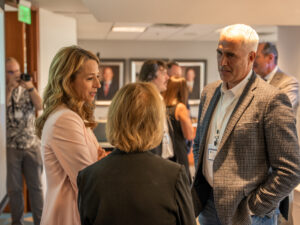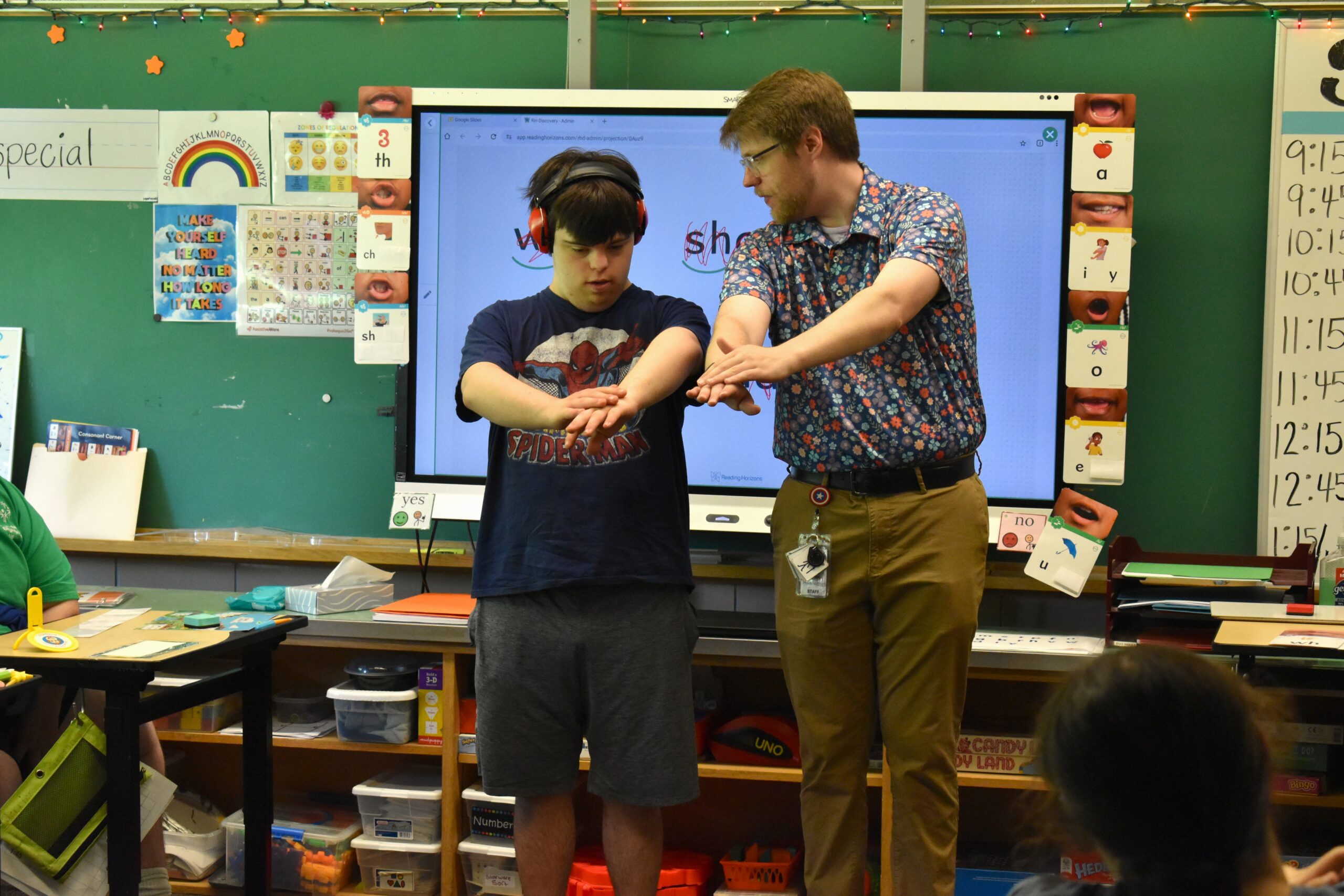
Holy Childhood high school teacher Joe Aldridge leads students with intellectual and developmental disabilities through a segmenting and blending exercise, using arm movements to connect sounds to letters.
ROCHESTER, N.Y. (June 16, 2026) — For most students, learning to read follows a familiar path. For the 120 students at Holy Childhood, that path has never been straightforward. Placed by public schools whose programs cannot meet their needs, these students, ages 5 through 22 from 40 different districts across New York, arrive with intellectual and developmental disabilities, some communicating through AAC devices, others just beginning to connect letters to sounds.
Three years ago, the Holy Childhood School Program piloted Reading Horizons® before moving to full implementation two years ago. They opened their classrooms to show what that instruction looks like in practice. The most recent results, collected from 35 students between September 2025 and January 2026, show meaningful gains across both middle and high school classrooms. High school students improved an average of 27.3% in consonant sound recognition and 47% in short vowel proficiency over that period. Middle school students showed a 17.1% average gain in consonant sounds and a 35.3% increase in short vowel proficiency.
“What Reading Horizons gave us was a place to start, an evidence-based, multi-modal foundation we could build on and make our own,” said Donna Moscicki, Director of School Program, Holy Childhood. “And what we have watched happen since then is nothing short of remarkable. Students reading full passages. Families calling us because their child recognized a word on a sign in the grocery store.”
Before Reading Horizons®, a structured literacy program that teaches students a systematic, repeatable process for decoding words, literacy instruction at the school was inconsistent across classrooms, with students largely relying on individual computer programs that offered little teacher-led structure or human connection. The shift changed that. Now every classroom follows the same instructional sequence and every teacher uses the same language. Students who move between grades encounter a framework they already know, which reduces cognitive load and supports the repetition and predictability these learners rely on.
The Reading Horizons® framework is adapted at every level. Mirrors help students see the shape of their mouths as they form sounds. Microphones encourage vocalization. Music is woven through lessons to build rhythm and pattern recognition. AAC devices, sign language support, letter magnets, and body movement all play a role. Speech-language pathologists and occupational therapists work alongside classroom teachers, and the whole team convenes monthly to review data and adjust instruction. Progress is tracked three times annually using the Reading Horizons® phonics screener, which measures each student’s growth in phonemic awareness, phonics, and letter and sound recognition against their own starting point, not against standard benchmarks.
“The research is clear: structured literacy develops the neural pathways that allow students to make progress, even when people have historically assumed they couldn’t,” said Laura Axtell, Education Specialist, Trainer and Presenter, Reading Horizons®. “What this school has done is take that foundation and build something extraordinary on top of it. When you walk into these classrooms, you see what happens when teachers are given a method they believe in, the training to implement it well, and the support to keep adapting it. That is what effective implementation looks like for students with intellectual and developmental disabilities.”
The national backdrop makes this work especially timely. According to the 2024 National Assessment of Educational Progress, just over 30% of fourth graders across the country are reading proficiently. The broader conversation, in Rochester and across the country, has largely centered on reaching students who could learn to read but aren’t. Holy Childhood has spent three years asking a harder question: How do you teach reading to students who learn best through alternative avenues? The educators here do not have a complete answer. But they are further along than most, and what they are building has implications well beyond Rochester.
###
About Holy Childhood Holy Childhood offers comprehensive and therapeutic services to a maximum of 120 students, ages 5-22 in the School Program. Students are transported from more than 40 regional school districts from Monroe and the six-county surrounding region. Full-day special education instruction is based on each student’s Individual Education Plan (IEP). Classrooms are 8:1:3 across all grade levels. Instruction includes emphasis on literacy, math, science, social activities of daily living, Work-Based Learning, music, art, adaptive physical education and transition training.
About Reading Horizons For over 40 years, Reading Horizons® has partnered with educators to combat illiteracy through effective, research-based reading instruction. Grounded in Structured Literacy, Reading Horizons provides Pre-K–12 core literacy, supplemental foundational and language literacy, and intervention solutions that help all students become confident readers. Learn more at readinghorizons.com and listen to Literacy Talks, a podcast exploring fresh perspectives on literacy, learning, and teaching.